butterfly 3 from south florida is the Dina Yellow.
Dina Yellow
Pyrisitia dina (Poey, 1832)
Family: Pieridae
Subfamily: Coliadinae
Identification: Male orange-yellow with very narrow black border on outer and costal margins of forewing. Female yellow with black at forewing tip. Underside of both sexes with three black spots on hindwing. Wet-season (summer) form paler colored.
Wing Span: 1 1/4 - 2 1/4 inches (3.2 - 5.7 cm).
Life History: Females lay many eggs on the same host plant.
Flight: Throughout the year in southern Florida. Strays into South Texas in November and southern Arizona in October.
Caterpillar Hosts: Mexican alvaradoa (Alvaradoa amorphoides) in Florida, bitterbush (Picramnia) in Central America; both in simarouba family.
Adult Food: In Central America this butterfly nectars at Lantana, Asclepias, and small-flowered Asteraceae.
Habitat: Forest edges, brushy fields, open forest.
Range: Panama north to southern Florida. Regularly visits south Texas and southeast Arizona.
Conservation: Not usually required. Avoid development of habitats in south Florida.
NCGR: G5 - Demonstrably secure globally, though it may be quite rare in parts of its range, especially at the periphery.
Management Needs: Avoid mosquito fogging of habitats. Maintain proper successional stages.
The second butterfly from south florida is the cassius blue.
Cassius Blue
Leptotes cassius (Cramer, 1775)
Family: Lycaenidae
Subfamily: Polyommatinae
Identification: Upperside of males pale blue; females with white patches. Underside tan with broken pale lines; forewing inner margin has "blank" areas with no spots.
Wing Span: 3/4 - 1 3/8 inches (2 - 3.5 cm).
Life History: Eggs are laid singly on flower buds of the host plant; caterpillars eat flowers and seedpods. Predation and parasitism may be discouraged by ants, which tend the caterpillars and feed on their sugary secretions.
Flight: All through the year in southern Florida and South Texas. Number of broods has not been determined.
Caterpillar Hosts: Ornamental leadwort (Plumbago capensis), rattlebox (Crotalaria incana), hairy milk pea (Galactia volubilis), and lima bean (Phaseolus limensis). Larva has been reared on the crenulate lead plant, Amorpha crenulata.
Adult Food: Nectar from shepherd's needle, lippia, and many other flowers.
Habitat: Subtropical thorn scrub, forest edges, weedy fields, residential areas.
Range: Florida and the Keys; Texas south through the West Indies, Mexico, and Central America to South America. Strays to New Mexico, Kansas, Missouri, and South Carolina.
Conservation: Not usually required.
NCGR: G5 - Demonstrably secure globally, though it may be quite rare in parts of its range, especially at the periphery.
Patti -- What a suprise to see you as my partner. Butterfly #1 from South Florida is the zebra longwing on a passion flower vine. I have one of these vines in my backyard.
Heliconius charithonia, the zebra longwing or zebra heliconian, is a species of butterfly belonging to the subfamily Heliconiinae of the family Nymphalidae. The boldly striped black and white wing pattern is aposematic, warning off predators. Wikipedia
Scientific name: Heliconius charithonia
Phylum: Arthropoda
Higher classification: Heliconius
Rank: Species
Order: Butterflies and moths
Did you know: The adult Zebra Longwing is mostly black with yellow stripes and spots.
Here are some butterflies from my state of Pennsylvania.
Male Black Swallowtail:
Female:
Black Swallowtail
Papilio polyxenes Fabricius, 1775
Family: Papilionidae
Subfamily: Papilioninae
Identification: Upper surface of wings mostly black; on inner edge of hindwing is a black spot centered in larger orange spot. Male has yellow band near edge of wings; female has row of yellow spots. Female hindwing with iridescent blue band. In the Southwest, yellow forms predominate in the subspecies P. coloro.
Wing Span: 3 1/4 - 4 1/4 inches (8 - 11 cm).
Life History: Males perch and patrol for receptive females. Female lays eggs singly on leaves and flowers of the host, which are then eaten by hatching larvae. Hibernates as a chrysalis.
Flight: One-2 flights from April-October in northern regions of range; 3 flights in southern regions.
Caterpillar Hosts: Leaves of plants in the parsley family (Apiaceae) including Queen Anne's Lace, carrot, celery and dill. Sometimes plants in the citrus family (Rutaceae) are preferred.
Adult Food: Nectar from flowers including red clover, milkweed, and thistles.
Habitat: A variety of open areas including fields, suburbs, marshes, deserts, and roadsides.
Range: Most of the eastern U.S., north into Quebec, west into s. Saskatchewan, Colorado and se. California; south to n. South America. Subspecies coloro in desert Southwest.
Conservation: Not usually of concern.
NCGR: G5 - Demonstrably secure globally, though it may be quite rare in parts of its range, especially at the periphery.
Identification: Upper surface of wings with black stripes on pale whitish-green background; hindwings have very long tails. Early-spring form is smaller and lighter colored.
Wing Span: 2 1/2 - 4 inches (6.4 - 10.4 cm).
Life History: Adult males fly in the understory near host plants to find females. Females lay single green eggs on lower leaves of host plant. Caterpillars live and feed on the underside of these leaves, then pupate and hibernate there.
Flight: Two flights, April-August, in the northern part of its range; many flights, March-December, in the south.
Caterpillar Hosts: Shrubs of the genus Asimina (pawpaw) in the Annonaceae family. Young plants are preferred.
Adult Food: Moisture from sand and nectar from flowers including blueberry, blackberry, lilac, redbud, viper\'s bugloss, verbena, dogbane, and common milkweed.
Habitat: Breeds in moist low woodlands near swamps and rivers. Adults fly to nectar plants in open fields and brushy areas.
Range: Rare in northern part of range.
Conservation: Not usually of concern.
NCGR: G5 - Demonstrably secure globally, though it may be quite rare in parts of its range, especially at the periphery.
Management Needs: Maintain host trees in various stages of succession.
Long Tailed Skipper:
Long-tailed Skipper
Urbanus proteus (Linnaeus, 1758)
Family: Hesperiidae
Subfamily: Pyrginae
Identification: Tails are long. Upperside is dark blackish brown; body and wing bases are iridescent blue-green. Males have a costal fold enclosing scent scales on the leading edge of the forewing. Dark row on underside of hindwing is a complete band.
Wing Span: 1 3/4 - 2 5/16 inches (4.5 - 6 cm).
Life History: Adults roost upside down under leaves and limbs. To seek females, males perch 3-6 feet above the ground in sunlit openings. Females lay eggs under leaves in clusters of up to 20. Caterpillars feed on leaves and live in shelters of rolled leaves.
Flight: Two to three broods throughout the year in south Florida and South Texas.
Caterpillar Hosts: Vine legumes including various beans (Phaseolus), hog peanuts (Amphicarpa bracteata), beggar's ticks (Desmodium), blue peas (Clitoria), and wisteria (Wisteria).
Adult Food: Flower nectar from a variety of plants including bougainvillea, lantana, and shepherd's needle.
Habitat: Brushy fields, edges of woods, gardens, and other disturbed open habitats.
Range: Argentina north through Central America, the West Indies, and Mexico to peninsular Florida and South Texas. Occasionally strays and colonizes north to Connecticut, southern Illinois, eastern Kansas, southern Arizona, and southern California.
Conservation: Not usually required.
NCGR: G5 - Demonstrably secure globally, though it may be quite rare in parts of its range, especially at the periphery.
Management Needs: Urbanus proteus caterpillars are sometimes pests on snap beans.
I am sorry I didn't include anything about Lavender. This is to correct that:
Lavender (Scientific Name: Lavandula) is one of the most fragrant and highly versatile herbs that you can grow. As you may already know, lavender is used in essential oils, perfumes, in aromatherapy, in traditional herbal medicine and in the kitchen as a culinary herb. Here are some other interesting facts about lavender that you may not know:
The name Lavender comes from the Latin verb, "lavare," which means to wash
Lavender comes from the same family as mint
Over 2500 years ago, lavender was used in ancient Egypt during the mummification process
Back in the Elizabethan times, when baths weren't common practice, lavender was used to perfume clothes and bed linen
The scent of lavender deters mice, flies, mosquitoes and other pests from the area
Lavender oil can be used to soothe aching muscles and joints, reduce anxiety and stress, and to induce sleep
It is a commonly used ingredient in potpourri
Nectar from lavender plants are used to make high quality honey
In the language of flowers, lavender can mean devotion, luck, success, happiness or distrust
Lavender plants don't produce seeds; propagation is done by cutting or root divisions
Most lavender plants are blue or purple, but there are some varieties that come in pink and yellow
Hello, I hope you enjoy this swap.
I always use lavender in my daughter's bath water, I was allergic to it, BUT since inhaling it little by little I am not allergic to it anymore. I love to study different herbs and flowers.
Lavender is from the mint family I love any herb from the mint family, I use them often
From Wikipedia
Lavandula (common name lavender) is a genus of 47 known species of flowering plants in the mint family, Lamiaceae. It is native to the Old World and is found from Cape Verde and the Canary Islands, Europe across to northern and eastern Africa, the Mediterranean, southwest Asia to southeast India. Many members of the genus are cultivated extensively in temperate climates as ornamental plants for garden and landscape use, for use as culinary herbs, and also commercially for the extraction of essential oils. The most widely cultivated species, Lavandula angustifolia, is often referred to as lavender, and there is a color named for the shade of the flowers of this species.
Hello, I hope you enjoy this swap.
I always use lavender in my daughter's bath water, I was allergic to it, BUT since inhaling it little by little I am not allergic to it anymore. I love to study different herbs and flowers.
Lavender is from the mint family I love any herb from the mint family, I use them often
From Wikipedia
Lavandula (common name lavender) is a genus of 47 known species of flowering plants in the mint family, Lamiaceae. It is native to the Old World and is found from Cape Verde and the Canary Islands, Europe across to northern and eastern Africa, the Mediterranean, southwest Asia to southeast India. Many members of the genus are cultivated extensively in temperate climates as ornamental plants for garden and landscape use, for use as culinary herbs, and also commercially for the extraction of essential oils. The most widely cultivated species, Lavandula angustifolia, is often referred to as lavender, and there is a color named for the shade of the flowers of this species.



Page 15 of tatntole's Comments
Back to tatntole's profile
Other pictures of butterflies from south florida Malachite black swallowtail
 Ruddy Daggarwing

butterfly 3 from south florida is the Dina Yellow.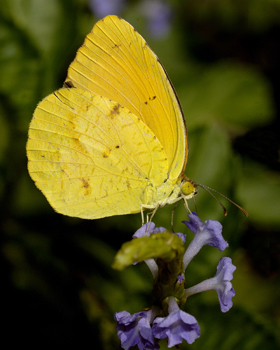 Dina Yellow
Pyrisitia dina (Poey, 1832)
Family: Pieridae
Subfamily: Coliadinae
Identification: Male orange-yellow with very narrow black border on outer and costal margins of forewing. Female yellow with black at forewing tip. Underside of both sexes with three black spots on hindwing. Wet-season (summer) form paler colored.
Wing Span: 1 1/4 - 2 1/4 inches (3.2 - 5.7 cm).
Life History: Females lay many eggs on the same host plant.
Flight: Throughout the year in southern Florida. Strays into South Texas in November and southern Arizona in October.
Caterpillar Hosts: Mexican alvaradoa (Alvaradoa amorphoides) in Florida, bitterbush (Picramnia) in Central America; both in simarouba family.
Adult Food: In Central America this butterfly nectars at Lantana, Asclepias, and small-flowered Asteraceae.
Habitat: Forest edges, brushy fields, open forest.
Range: Panama north to southern Florida. Regularly visits south Texas and southeast Arizona.
Conservation: Not usually required. Avoid development of habitats in south Florida.
NCGR: G5 - Demonstrably secure globally, though it may be quite rare in parts of its range, especially at the periphery.
Management Needs: Avoid mosquito fogging of habitats. Maintain proper successional stages.
Dina Yellow
Pyrisitia dina (Poey, 1832)
Family: Pieridae
Subfamily: Coliadinae
Identification: Male orange-yellow with very narrow black border on outer and costal margins of forewing. Female yellow with black at forewing tip. Underside of both sexes with three black spots on hindwing. Wet-season (summer) form paler colored.
Wing Span: 1 1/4 - 2 1/4 inches (3.2 - 5.7 cm).
Life History: Females lay many eggs on the same host plant.
Flight: Throughout the year in southern Florida. Strays into South Texas in November and southern Arizona in October.
Caterpillar Hosts: Mexican alvaradoa (Alvaradoa amorphoides) in Florida, bitterbush (Picramnia) in Central America; both in simarouba family.
Adult Food: In Central America this butterfly nectars at Lantana, Asclepias, and small-flowered Asteraceae.
Habitat: Forest edges, brushy fields, open forest.
Range: Panama north to southern Florida. Regularly visits south Texas and southeast Arizona.
Conservation: Not usually required. Avoid development of habitats in south Florida.
NCGR: G5 - Demonstrably secure globally, though it may be quite rare in parts of its range, especially at the periphery.
Management Needs: Avoid mosquito fogging of habitats. Maintain proper successional stages.
The second butterfly from south florida is the cassius blue. Cassius Blue
Leptotes cassius (Cramer, 1775)
Family: Lycaenidae
Subfamily: Polyommatinae
Identification: Upperside of males pale blue; females with white patches. Underside tan with broken pale lines; forewing inner margin has "blank" areas with no spots.
Wing Span: 3/4 - 1 3/8 inches (2 - 3.5 cm).
Life History: Eggs are laid singly on flower buds of the host plant; caterpillars eat flowers and seedpods. Predation and parasitism may be discouraged by ants, which tend the caterpillars and feed on their sugary secretions.
Flight: All through the year in southern Florida and South Texas. Number of broods has not been determined.
Caterpillar Hosts: Ornamental leadwort (Plumbago capensis), rattlebox (Crotalaria incana), hairy milk pea (Galactia volubilis), and lima bean (Phaseolus limensis). Larva has been reared on the crenulate lead plant, Amorpha crenulata.
Adult Food: Nectar from shepherd's needle, lippia, and many other flowers.
Habitat: Subtropical thorn scrub, forest edges, weedy fields, residential areas.
Range: Florida and the Keys; Texas south through the West Indies, Mexico, and Central America to South America. Strays to New Mexico, Kansas, Missouri, and South Carolina.
Conservation: Not usually required.
NCGR: G5 - Demonstrably secure globally, though it may be quite rare in parts of its range, especially at the periphery.
Cassius Blue
Leptotes cassius (Cramer, 1775)
Family: Lycaenidae
Subfamily: Polyommatinae
Identification: Upperside of males pale blue; females with white patches. Underside tan with broken pale lines; forewing inner margin has "blank" areas with no spots.
Wing Span: 3/4 - 1 3/8 inches (2 - 3.5 cm).
Life History: Eggs are laid singly on flower buds of the host plant; caterpillars eat flowers and seedpods. Predation and parasitism may be discouraged by ants, which tend the caterpillars and feed on their sugary secretions.
Flight: All through the year in southern Florida and South Texas. Number of broods has not been determined.
Caterpillar Hosts: Ornamental leadwort (Plumbago capensis), rattlebox (Crotalaria incana), hairy milk pea (Galactia volubilis), and lima bean (Phaseolus limensis). Larva has been reared on the crenulate lead plant, Amorpha crenulata.
Adult Food: Nectar from shepherd's needle, lippia, and many other flowers.
Habitat: Subtropical thorn scrub, forest edges, weedy fields, residential areas.
Range: Florida and the Keys; Texas south through the West Indies, Mexico, and Central America to South America. Strays to New Mexico, Kansas, Missouri, and South Carolina.
Conservation: Not usually required.
NCGR: G5 - Demonstrably secure globally, though it may be quite rare in parts of its range, especially at the periphery.
Patti -- What a suprise to see you as my partner. Butterfly #1 from South Florida is the zebra longwing on a passion flower vine. I have one of these vines in my backyard. Heliconius charithonia, the zebra longwing or zebra heliconian, is a species of butterfly belonging to the subfamily Heliconiinae of the family Nymphalidae. The boldly striped black and white wing pattern is aposematic, warning off predators. Wikipedia
Scientific name: Heliconius charithonia
Phylum: Arthropoda
Higher classification: Heliconius
Rank: Species
Order: Butterflies and moths
Did you know: The adult Zebra Longwing is mostly black with yellow stripes and spots.
Heliconius charithonia, the zebra longwing or zebra heliconian, is a species of butterfly belonging to the subfamily Heliconiinae of the family Nymphalidae. The boldly striped black and white wing pattern is aposematic, warning off predators. Wikipedia
Scientific name: Heliconius charithonia
Phylum: Arthropoda
Higher classification: Heliconius
Rank: Species
Order: Butterflies and moths
Did you know: The adult Zebra Longwing is mostly black with yellow stripes and spots.
BL ~ Butterflies From Our State or Country #3
Here are some butterflies from my state of Pennsylvania.
Male Black Swallowtail:
Female:
Black Swallowtail Papilio polyxenes Fabricius, 1775
Family: Papilionidae
Subfamily: Papilioninae
Identification: Upper surface of wings mostly black; on inner edge of hindwing is a black spot centered in larger orange spot. Male has yellow band near edge of wings; female has row of yellow spots. Female hindwing with iridescent blue band. In the Southwest, yellow forms predominate in the subspecies P. coloro.
Wing Span: 3 1/4 - 4 1/4 inches (8 - 11 cm).
Life History: Males perch and patrol for receptive females. Female lays eggs singly on leaves and flowers of the host, which are then eaten by hatching larvae. Hibernates as a chrysalis.
Flight: One-2 flights from April-October in northern regions of range; 3 flights in southern regions.
Caterpillar Hosts: Leaves of plants in the parsley family (Apiaceae) including Queen Anne's Lace, carrot, celery and dill. Sometimes plants in the citrus family (Rutaceae) are preferred.
Adult Food: Nectar from flowers including red clover, milkweed, and thistles.
Habitat: A variety of open areas including fields, suburbs, marshes, deserts, and roadsides.
Range: Most of the eastern U.S., north into Quebec, west into s. Saskatchewan, Colorado and se. California; south to n. South America. Subspecies coloro in desert Southwest.
Conservation: Not usually of concern.
NCGR: G5 - Demonstrably secure globally, though it may be quite rare in parts of its range, especially at the periphery.
Management Needs: Maintain open fields in East.
Zebra Swallowtail Eurytides marcellus (Cramer, 1777)
Family: Papilionidae
Subfamily: Papilioninae
Identification: Upper surface of wings with black stripes on pale whitish-green background; hindwings have very long tails. Early-spring form is smaller and lighter colored.
Wing Span: 2 1/2 - 4 inches (6.4 - 10.4 cm).
Life History: Adult males fly in the understory near host plants to find females. Females lay single green eggs on lower leaves of host plant. Caterpillars live and feed on the underside of these leaves, then pupate and hibernate there.
Flight: Two flights, April-August, in the northern part of its range; many flights, March-December, in the south.
Caterpillar Hosts: Shrubs of the genus Asimina (pawpaw) in the Annonaceae family. Young plants are preferred.
Adult Food: Moisture from sand and nectar from flowers including blueberry, blackberry, lilac, redbud, viper\'s bugloss, verbena, dogbane, and common milkweed.
Habitat: Breeds in moist low woodlands near swamps and rivers. Adults fly to nectar plants in open fields and brushy areas.
Range: Rare in northern part of range.
Conservation: Not usually of concern.
NCGR: G5 - Demonstrably secure globally, though it may be quite rare in parts of its range, especially at the periphery.
Management Needs: Maintain host trees in various stages of succession.
Long Tailed Skipper:
Long-tailed Skipper Urbanus proteus (Linnaeus, 1758)
Family: Hesperiidae
Subfamily: Pyrginae
Identification: Tails are long. Upperside is dark blackish brown; body and wing bases are iridescent blue-green. Males have a costal fold enclosing scent scales on the leading edge of the forewing. Dark row on underside of hindwing is a complete band.
Wing Span: 1 3/4 - 2 5/16 inches (4.5 - 6 cm).
Life History: Adults roost upside down under leaves and limbs. To seek females, males perch 3-6 feet above the ground in sunlit openings. Females lay eggs under leaves in clusters of up to 20. Caterpillars feed on leaves and live in shelters of rolled leaves.
Flight: Two to three broods throughout the year in south Florida and South Texas.
Caterpillar Hosts: Vine legumes including various beans (Phaseolus), hog peanuts (Amphicarpa bracteata), beggar's ticks (Desmodium), blue peas (Clitoria), and wisteria (Wisteria).
Adult Food: Flower nectar from a variety of plants including bougainvillea, lantana, and shepherd's needle.
Habitat: Brushy fields, edges of woods, gardens, and other disturbed open habitats.
Range: Argentina north through Central America, the West Indies, and Mexico to peninsular Florida and South Texas. Occasionally strays and colonizes north to Connecticut, southern Illinois, eastern Kansas, southern Arizona, and southern California.
Conservation: Not usually required.
NCGR: G5 - Demonstrably secure globally, though it may be quite rare in parts of its range, especially at the periphery.
Management Needs: Urbanus proteus caterpillars are sometimes pests on snap beans.
I hope you enjoyed this information.
Blessings,
Yvonne
EF~DisneyNature Movie Series #1 - Pandas
I hope you like the pics and gifs that I've chosen for you!
I hope you enjoyed!
Blessings,
Yvonne
I am sorry I didn't include anything about Lavender. This is to correct that:
Lavender (Scientific Name: Lavandula) is one of the most fragrant and highly versatile herbs that you can grow. As you may already know, lavender is used in essential oils, perfumes, in aromatherapy, in traditional herbal medicine and in the kitchen as a culinary herb. Here are some other interesting facts about lavender that you may not know:
The name Lavender comes from the Latin verb, "lavare," which means to wash Lavender comes from the same family as mint Over 2500 years ago, lavender was used in ancient Egypt during the mummification process Back in the Elizabethan times, when baths weren't common practice, lavender was used to perfume clothes and bed linen The scent of lavender deters mice, flies, mosquitoes and other pests from the area Lavender oil can be used to soothe aching muscles and joints, reduce anxiety and stress, and to induce sleep It is a commonly used ingredient in potpourri Nectar from lavender plants are used to make high quality honey In the language of flowers, lavender can mean devotion, luck, success, happiness or distrust Lavender plants don't produce seeds; propagation is done by cutting or root divisions Most lavender plants are blue or purple, but there are some varieties that come in pink and yellow
APDG ~ Happy Mother's Day Deco Swap Mail Deadline: May 14, 2017
EF Flowers #2 Lavender
Hello, I hope you enjoy this swap. I always use lavender in my daughter's bath water, I was allergic to it, BUT since inhaling it little by little I am not allergic to it anymore. I love to study different herbs and flowers.
Lavender is from the mint family I love any herb from the mint family, I use them often
From Wikipedia
Lavandula (common name lavender) is a genus of 47 known species of flowering plants in the mint family, Lamiaceae. It is native to the Old World and is found from Cape Verde and the Canary Islands, Europe across to northern and eastern Africa, the Mediterranean, southwest Asia to southeast India. Many members of the genus are cultivated extensively in temperate climates as ornamental plants for garden and landscape use, for use as culinary herbs, and also commercially for the extraction of essential oils. The most widely cultivated species, Lavandula angustifolia, is often referred to as lavender, and there is a color named for the shade of the flowers of this species.
EF Flowers #2 Lavender
Hello, I hope you enjoy this swap. I always use lavender in my daughter's bath water, I was allergic to it, BUT since inhaling it little by little I am not allergic to it anymore. I love to study different herbs and flowers.
Lavender is from the mint family I love any herb from the mint family, I use them often
From Wikipedia
Lavandula (common name lavender) is a genus of 47 known species of flowering plants in the mint family, Lamiaceae. It is native to the Old World and is found from Cape Verde and the Canary Islands, Europe across to northern and eastern Africa, the Mediterranean, southwest Asia to southeast India. Many members of the genus are cultivated extensively in temperate climates as ornamental plants for garden and landscape use, for use as culinary herbs, and also commercially for the extraction of essential oils. The most widely cultivated species, Lavandula angustifolia, is often referred to as lavender, and there is a color named for the shade of the flowers of this species.